Jump back to chapter selection: chapter selection.
Table of Contents
6.1 Surface Plasmon Polaritons at THz Frequencies
6.2 Excitation of Acoustic Surface Plasmons
6.3 Designer Surface Plasmon Polaritons
6 Electromagnetic Surface Modes at Low Frequencies
We have seen that surface plasmon polaritons can confine electromagnetic fields to the interface between a dielectric and a conductor over length scales significantly smaller than the free-space wavelength. This high field localisation is strongest when the optical frequency is not too far below the intrinsic plasma frequency of the conductor. At much lower frequencies, the SPP dispersion relation approaches the light line of the dielectric. The propagation constant then becomes almost indistinguishable from the wave vector of ordinary radiation in the dielectric, and the surface confinement breaks down.
For typical noble metals such as gold and silver, SPPs therefore evolve into grazing-incidence light fields when the frequency is lowered. A mode that was once tightly bound to the interface extends over many wavelengths into the dielectric and propagates with almost the same phase velocity as unbound radiation. Microscopically, this happens because an appreciable electric field inside the metal is required to build the oscillating surface charge distribution. In the perfect-conductor limit the field penetration vanishes, the tangential electric field at the surface is forced to zero, and the usual SPP disappears.
There are two important ways around this limitation. Highly doped semiconductors can shift the plasma frequency into the mid-IR or THz range, making low-frequency SPPs possible at the cost of larger absorption. Alternatively, a structured metal surface can mimic the dispersion of a plasmonic surface even when the metal itself behaves almost like a perfect conductor. These artificial modes are often called designer plasmons.
6.1 Surface Plasmon Polaritons at THz Frequencies
As discussed earlier, the localisation and concomitant field enhancement coming from SPPs at the interface is due to a large in-plane propagation constant
For two media with permittivities
Here
Metals have a large free electron density
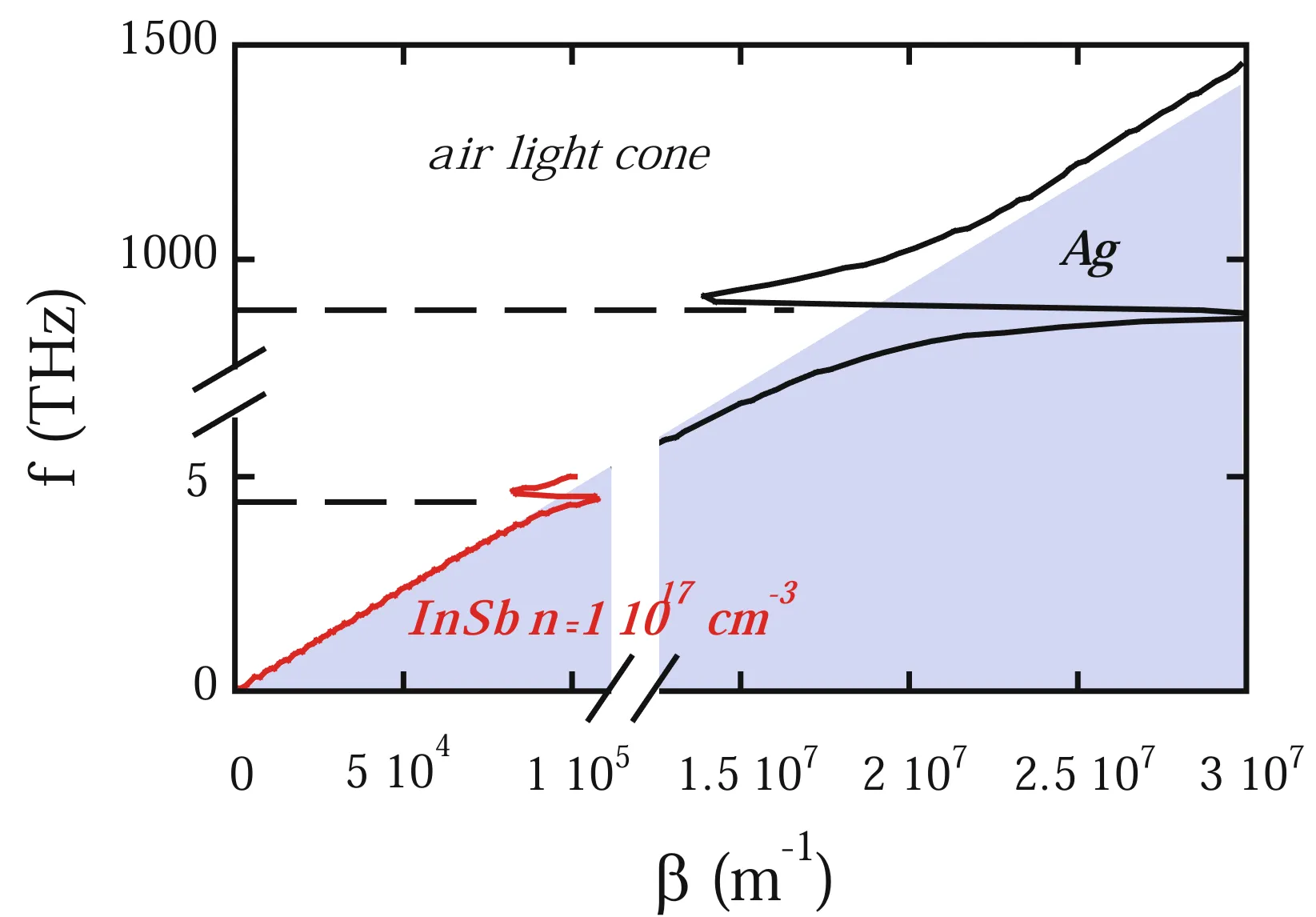
We see that
The figure above also shows the SPP dispersion relation for the interface between air and highly doped InSb. Due to the lower free electron density
6.2 Excitation of Acoustic Surface Plasmons
Acoustic surface plasmons are expected to be excitable not only by moving electrons, but also by light. As with conventional surface plasmons, free-space light alone usually cannot provide the required in-plane momentum. The missing momentum can be supplied by a deliberately structured surface, for example a periodic grating.
Consider a periodic grating of constant

If light hits such a surface at an angle
where
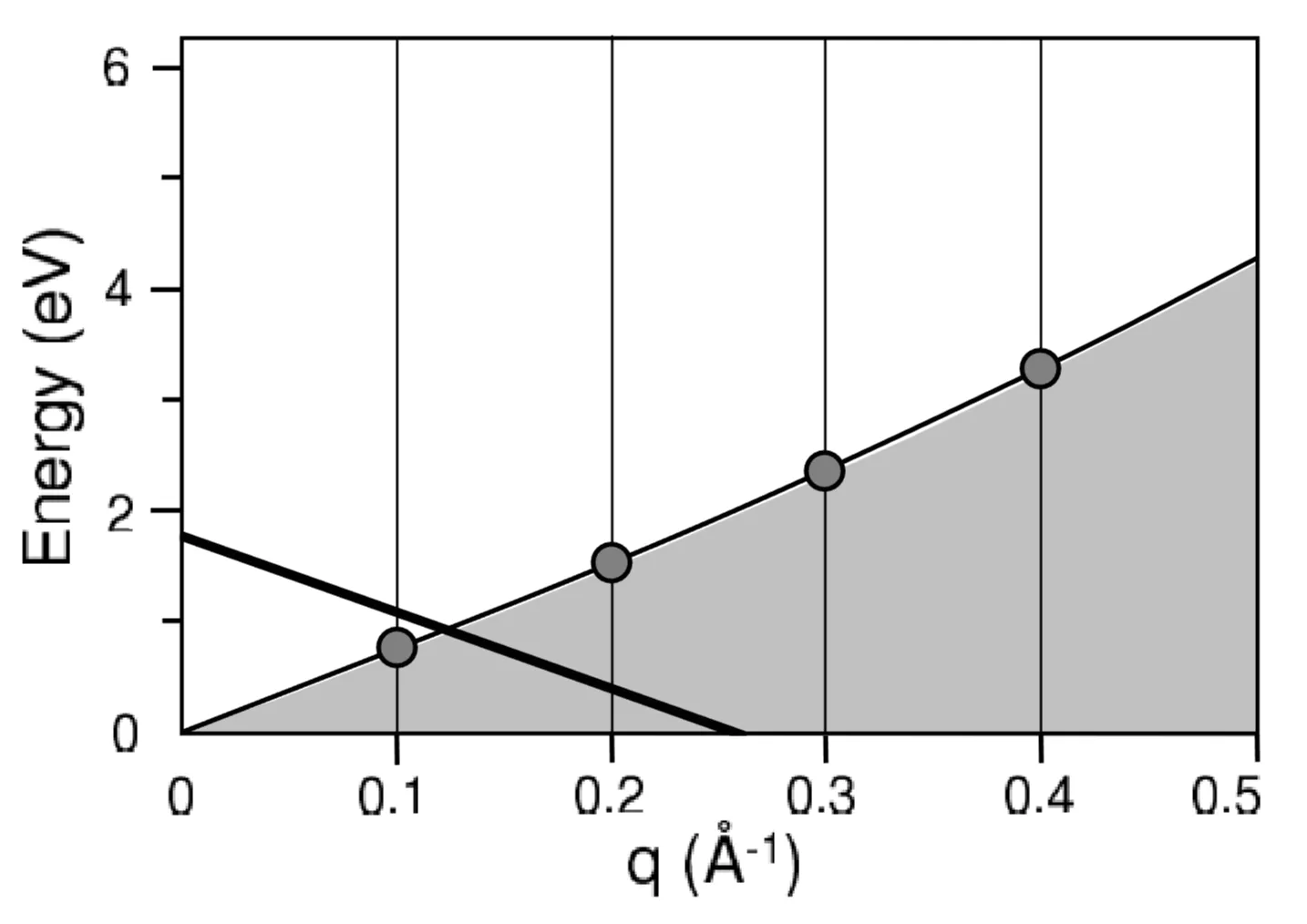
The key point is the same as for prism or grating coupling in chapter 3: the surface structure changes the momentum bookkeeping. Once the phase-matching condition is satisfied, optical excitation of a mode that would otherwise be inaccessible becomes possible.
6.3 Designer Surface Plasmon Polaritons
At microwave and THz frequencies, real metals are often close to perfect conductors. A flat perfect conductor cannot support a conventional SPP because the tangential electric field at the surface vanishes and no longitudinal surface-charge oscillation can be sustained. However, if the surface is textured with grooves, holes, or corrugations, electromagnetic fields can penetrate into the subwavelength structure and acquire an effective surface impedance.
The structured surface then behaves as an artificial medium. Its geometry creates a bound mode whose dispersion can be engineered to look similar to that of an optical SPP. The field is not bound because the metal has a plasmonic dielectric function in the Drude sense; it is bound because the surface pattern stores electromagnetic energy and modifies the boundary condition seen by the propagating wave.
This is the physical meaning of designer plasmons:
- The operating frequency is set mainly by the surface geometry rather than by the intrinsic plasma frequency of the metal.
- The confinement can be tuned by changing groove depth, period, filling factor, or hole geometry.
- Losses are often dominated by ohmic dissipation and fabrication imperfections, not by interband absorption.
- The same design idea can be scaled from microwave frequencies into the THz and far-infrared regimes.
Designer SPPs are therefore useful when one wants plasmon-like confinement at frequencies where ordinary noble-metal SPPs would be too weakly bound. Conceptually, they also clarify the difference between a true material plasmon and a surface electromagnetic mode whose dispersion has been engineered to mimic plasmonic behaviour.